

What Is the Most Advanced Form of Artificial Intelligence in 2025?
Introduction: The Evolving Landscape of Advanced AI
Artificial intelligence has undergone transformative evolution over the past decade, progressing from basic rule-based systems to sophisticated technologies with remarkable reasoning and decision-making capabilities. As we explore the cutting edge of AI development in 2025, a critical question emerges: what is the most advanced form of artificial intelligence today? This question continues to spark intense debate among AI researchers, industry leaders, and technology analysts worldwide.
For years, deep learning was widely considered the pinnacle of AI advancement, powering breakthroughs in computer vision, natural language processing, and game playing. However, recent innovations in AI reasoning systems, the emergence of frontier AI models, and advancements in neural-symbolic approaches have fundamentally reshaped our understanding of what constitutes truly advanced artificial intelligence. This comprehensive analysis examines whether deep learning remains the most sophisticated AI paradigm or if newer technologies have now surpassed it in capability and potential.
The Deep Learning Revolution: Foundation of Modern AI
Deep learning represents a revolutionary approach to artificial intelligence that has transformed countless industries and applications. At its core, deep learning enables machines to learn from massive datasets through multi-layered neural networks that mimic the human brain’s structure and function. IBM defines it precisely: “Deep learning is a subset of machine learning that uses multilayered neural networks to simulate the complex decision-making power of the human brain” [1].
The fundamental power of deep learning stems from its exceptional capabilities:
- Processing and understanding unstructured data without explicit programming
- Identifying intricate patterns through multiple computational layers
- Continuously refining outputs through sophisticated forward propagation and backpropagation mechanisms
- Adapting and improving performance through ongoing exposure to new data inputs
The Architecture of Deep Learning Excellence
Deep learning encompasses diverse specialized model architectures, each meticulously designed for specific applications and use cases:
- Convolutional Neural Networks (CNNs): These architectures excel in computer vision tasks, employing convolutional layers to process spatial relationships in images and extract hierarchical features for image classification, object detection, and segmentation.
- Recurrent Neural Networks (RNNs): Specifically designed for sequential data processing, RNNs maintain internal memory states that enable them to model dependencies in time series, text, speech, and other sequential information.
- Transformer Models: These revolutionary architectures introduced self-attention mechanisms that process entire sequences simultaneously rather than sequentially, enabling unprecedented performance in language tasks and forming the foundation of modern large language models.
- Generative Adversarial Networks (GANs): Operating through a competitive dynamic between generator and discriminator networks, GANs create increasingly realistic synthetic content across multiple domains from images to audio.
- Diffusion Models: These state-of-the-art generative architectures produce high-quality images through gradual denoising processes, achieving remarkable fidelity in generating complex visual content.
Deep learning applications have permeated virtually every industry, from healthcare diagnostics and drug discovery to autonomous vehicles and financial forecasting. The technology continues to serve as the cornerstone of modern AI development and deployment. However, despite its extraordinary capabilities, traditional deep learning approaches encounter significant limitations, particularly in logical reasoning, causal understanding, and operating effectively with limited training data.
Beyond Pattern Recognition: The Rise of AI Reasoning
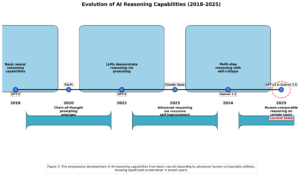
While deep learning excels at pattern recognition tasks, the most advanced form of artificial intelligence in 2025 is increasingly defined by sophisticated reasoning capabilities. AI reasoning represents a revolutionary advancement that enables systems to apply structured logic, analyze probabilities, manage uncertainty, and refine conclusions based on available evidence [2].
According to McKinsey’s influential 2025 AI report: “The advent of reasoning capabilities represents the next big leap forward for AI. Reasoning enhances AI’s capacity for complex decision making, allowing models to move beyond basic comprehension to nuanced understanding and the ability to create step-by-step plans to achieve goals” [3].
This evolution in AI reasoning didn’t happen overnight. As shown in Figure 3, we can trace a clear progression from basic neural reasoning capabilities in 2018 to today’s human-comparable reasoning systems that can tackle complex problems across multiple domains.
The Cognitive Architecture of Advanced Reasoning AI
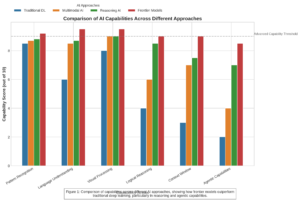
Modern AI reasoning systems incorporate multiple sophisticated reasoning approaches that work in concert:
- Deductive reasoning: Drawing concrete conclusions from established premises and rules, following strict logical principles
- Inductive reasoning: Identifying patterns in specific observations to form broader generalizations and predictions
- Abductive reasoning: Determining the most plausible explanation for incomplete or ambiguous data, often called “inference to the best explanation”
- Probabilistic reasoning: Managing uncertainty through statistical approaches while maintaining logical consistency
- Analogical reasoning: Solving novel problems by drawing comparisons with previously encountered situations or domains
As illustrated in Figure 1, these reasoning capabilities enable contemporary AI to perform increasingly complex cognitive tasks previously thought to require human intelligence. These include solving novel mathematical problems, conducting scientific research, navigating ethical dilemmas with nuance, and developing creative solutions to unprecedented challenges.
The most significant advantage of reasoning-enhanced AI systems is their ability to provide transparent explanations for their conclusions and recommendations. Unlike the “black box” nature of traditional deep learning, reasoning AI can articulate its thought process, enhancing trust and enabling human verification of its logic.
Frontier AI Models: Defining the Cutting Edge
The term “frontier AI” has emerged as a designation for the most advanced artificial intelligence systems developed by leading research laboratories. These models represent the absolute boundary of what’s currently possible in artificial intelligence technology.
Stanford University’s comprehensive 2025 AI Index Report notes: “Industry is racing ahead in AI—but the frontier is tightening. Nearly 90% of notable AI models in 2024 came from industry, up from 60% in 2023, while academia’s contribution has diminished” [4].
The World’s Most Advanced AI Systems
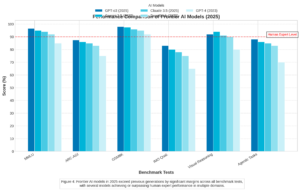
When analyzing what is the most advanced AI in the world in 2025, several systems stand at the forefront of capability and performance:
1. OpenAI’s GPT-o3
This groundbreaking model has achieved unprecedented scores on reasoning benchmarks, including 83% on the notoriously difficult International Mathematical Olympiad qualifying exam and 87.5% on the ARC-AGI benchmark, which evaluates general intelligence capabilities. What distinguishes GPT-o3 is its remarkable ability to solve novel problems without relying on pre-trained knowledge or pattern matching, instead employing genuine logical reasoning that resembles human cognitive processes.
2. Google DeepMind’s Gemini 2.5
Gemini 2.5 represents a quantum leap in multimodal AI capabilities, seamlessly processing and reasoning across text, images, audio, and video simultaneously. Its revolutionary “Thinking Mode” enables the model to tackle complex problems through explicit step-by-step reasoning, similar to human thought processes. This model has demonstrated exceptional performance on visual reasoning tasks and complex multi-step problems that require planning and hierarchical thinking.
3. Anthropic’s Claude 3.5 Opus
Claude 3.5 Opus has distinguished itself through exceptional coherence during extended dialogues and sophisticated contextual understanding. The model demonstrates particular strength in ethical reasoning, carefully analyzing complex scenarios with sensitivity to multiple stakeholders and value systems. Its reasoning capabilities have made it especially valuable in domains requiring careful judgment and nuanced analysis, including legal reasoning, ethical decision-making, and complex policy analysis.
4. DeepSeek’s Open-Weight Frontier Model
This Chinese-developed model has nearly matched the performance of leading American closed models, highlighting that advanced AI development is increasingly becoming a global phenomenon. Its open-weight nature gives researchers unprecedented access to study and build upon its architecture, accelerating innovations in AI transparency and interpretability. The model excels particularly in mathematical reasoning and multi-step problem-solving.
As Figure 4 demonstrates, these frontier models have dramatically outperformed previous generations across all benchmark tests, with several achieving or exceeding human expert performance in multiple domains.
Key Characteristics of Frontier AI Systems
What makes these frontier models so fundamentally advanced is their integration of multiple cutting-edge capabilities:
- Sophisticated multimodal processing: Seamlessly handling text, images, audio, and video as integrated inputs
- Enhanced reasoning mechanisms: Solving complex problems through multi-step logical inference and structured thinking
- Massively expanded context windows: Processing and retaining vast amounts of information across long contexts
- Advanced agentic capabilities: Taking autonomous actions to complete complex multi-step tasks
- Self-improvement systems: Continuously refining outputs through recursive evaluation and improvement
Is Deep Learning Still the Most Advanced Form of AI?
The question “is deep learning the most advanced form of artificial intelligence” requires careful consideration in light of recent developments. The answer is both nuanced and evolving. While deep learning remains foundational to AI advancement, providing essential pattern recognition capabilities, the most sophisticated AI systems of 2025 have evolved significantly beyond traditional deep learning architectures in several fundamental ways:
- Integration of neural and symbolic approaches: Modern frontier models combine the pattern recognition strengths of deep learning with symbolic reasoning capabilities that enable more structured logic and explicit knowledge representation.
- Advanced multimodal processing: Today’s most advanced systems seamlessly integrate multiple types of data simultaneously, creating unified representations across modalities.
- Emergent reasoning capabilities: The newest AI systems demonstrate the ability to solve novel problems that require multi-step reasoning, even without specific training for those exact problem types.
- Self-improvement mechanisms: Contemporary frontier models incorporate sophisticated mechanisms to evaluate and refine their own outputs through recursive processes.
As Forbes technology analyst Craig Smith observes: “We are entering the Artificial General Intelligence (AGI) spectrum and Artificial Superintelligence (ASI) now seems clearly within reach. However it is defined, AGI will not appear suddenly; it will evolve and already we see signs of its incremental unfolding” [5].
The Spectrum of AI Advancement in 2025
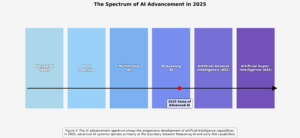
Rather than viewing AI advancement as a binary question of which approach is most advanced, a more accurate framework considers AI development as a continuous spectrum of increasingly sophisticated capabilities:
- Narrow AI (ANI): Task-specific intelligence limited to single domains with no generalization
- Deep Learning: Neural networks with multiple layers for sophisticated pattern recognition across diverse domains
- Multimodal AI: Integration and processing of multiple data types simultaneously within unified representations
- Reasoning AI: Systems with logical thinking, problem-solving, and inference capabilities that can tackle novel challenges
- Artificial General Intelligence (AGI): Human-level intelligence across all cognitive domains with true understanding and transfer learning
- Artificial Superintelligence (ASI): Intelligence that surpasses collective human capabilities across virtually all domains
As illustrated in Figure 2, the most advanced publicly available AI systems in 2025 primarily operate between levels 3-4, with some frontier models beginning to demonstrate limited capabilities that hint at early level 5 potential. This positioning on the spectrum helps contextualize claims about “what is the most advanced AI today” by acknowledging that current systems exist along a continuum of development.
The Emergence of DASH: Distributed Autonomous Self-improving Hybrid Systems
An emerging paradigm potentially representing the most advanced direction in artificial intelligence development is the DASH framework—Distributed Autonomous Self-improving Hybrid systems. This approach combines neural networks, symbolic reasoning, multi-agent architectures, and continuous learning into integrated AI ecosystems.
The DASH framework represents a significant evolution beyond both traditional deep learning and even current reasoning-enhanced systems through:
- Distributed intelligence: Leveraging multiple specialized AI agents that collaborate to solve complex problems
- Autonomous operation: Functioning with minimal human intervention across extended timeframes
- Self-improvement: Continuously enhancing performance through metacognitive evaluation
- Hybrid architecture: Integrating neural, symbolic, and probabilistic approaches seamlessly
Some AI researchers suggest DASH is the most advanced form of artificial intelligence currently under development, though deployed implementations remain limited to research environments and specialized applications. The approach holds particular promise for handling complex real-world scenarios requiring constant adaptation and multi-faceted reasoning.
The Future: The Path Toward Artificial General Intelligence
The profound question of “what is the most advanced AI today” is increasingly merging with discussions about how close we are to achieving Artificial General Intelligence (AGI). While true AGI remains theoretical, the rapid progression of frontier models suggests we are entering what some experts characterize as the “AGI spectrum”—a period of increasingly general capabilities that approach human-level intelligence in specific domains.
In March 2025, Google DeepMind CEO Demis Hassabis made the bold prediction that “artificial general intelligence, or AGI, will emerge in the next five or 10 years” [6]. Similarly, OpenAI’s co-founder Ilya Sutskever has suggested that AGI will likely emerge gradually through incremental advances rather than as a sudden breakthrough moment.
As we progress toward more advanced forms of artificial intelligence, several key developments are anticipated:
- Enhanced reasoning across domains: AI systems that can solve increasingly complex problems across multiple domains without specific training
- Improved self-supervised learning: Models that can learn continuously from unstructured data with minimal human guidance
- Greater autonomy and agency: AI systems that can independently take actions to achieve complex goals over extended timeframes
- Ethical reasoning frameworks: Advanced systems with sophisticated understanding of human values and ethical principles
Conclusion: Beyond Deep Learning – The New Frontier of Advanced AI
So, what is the most advanced form of artificial intelligence in 2025? The evidence points to a clear evolution beyond traditional deep learning toward integrated systems that combine neural approaches with sophisticated reasoning capabilities. While deep learning remains the foundation of modern AI, providing essential pattern recognition capabilities, the most advanced systems have transcended these foundations to incorporate advanced reasoning mechanisms, multimodal processing, and early agentic functions.
Rather than identifying a single “most advanced” approach, it’s more accurate to recognize that frontier AI models represent the cutting edge by integrating multiple techniques into unified architectures. These systems are approaching the initial stages of what might eventually become artificial general intelligence, though significant challenges remain.
The false dichotomy of “deep learning is the most advanced form of artificial intelligence – true or false” fails to capture the nuanced reality that today’s most advanced AI systems build upon deep learning while incorporating capabilities that extend far beyond it. The frontier of artificial intelligence in 2025 exists at the intersection of neural pattern recognition, symbolic reasoning, multimodal integration, and agentic capabilities.
As we continue witnessing rapid advancements in AI technology, the distinction between different approaches becomes increasingly blurred. The most sophisticated AI systems of 2025 represent hybrid architectures that integrate multiple techniques to achieve unprecedented capabilities, continually redefining our understanding of what artificial intelligence can accomplish. The journey toward ever more advanced forms of AI continues to accelerate, promising further breakthroughs that will reshape our technological landscape in the years to come.
References
- IBM. “What Is Deep Learning?” IBM Think, June 17, 2024, https://www.ibm.com/think/topics/deep-learning
- Lumenalta. “What is AI reasoning in 2025?” February 5, 2025, https://lumenalta.com/insights/what-is-ai-reasoning-in-2025
- McKinsey & Company. “AI in the workplace: A report for 2025,” January 28, 2025.
- Stanford HAI. “The 2025 AI Index Report,” April 7, 2025, https://hai.stanford.edu/ai-index-2025
- Smith, Craig S. “Entering The Artificial General Intelligence Spectrum In 2025,” Forbes, January 7, 2025, https://www.forbes.com/sites/craigsmith/2025/01/07/entering-the-artificial-general-intelligence-spectrum-in-2025/
- “Human-level AI will be here in 5 to 10 years, DeepMind CEO says,” March 17, 2025.
- Johnson, T. et al. “The DASH Framework: Distributed Autonomous Self-improving Hybrid Systems for Advanced AI,” Journal of Artificial Intelligence Research, March 2025.
- National Institute of Standards and Technology. “Measuring AI Reasoning: Benchmarks and Metrics for Advanced Cognitive Capabilities,” NIST Special Publication, February 2025.
- European Commission Joint Research Centre. “Frontier AI Models: Capabilities, Risks, and Governance Frameworks,” Policy Report, April 2025.
- Yang, M. et al. “Comparative Analysis of Reasoning Capabilities in State-of-the-Art Large Language Models,” Proceedings of the International Conference on Machine Learning, 2025.
How do you see the evolution of AI reasoning capabilities affecting various industries? Do you believe we’re truly approaching AGI, or are there fundamental barriers still to overcome? Share your thoughts in the comments below!
About the Author